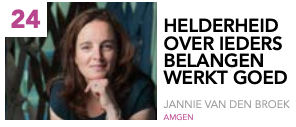
Since 2015, Amgen Netherlands has been working hard on value-based healthcare. The biotech company in Breda has entered into partnerships with six hospitals for projects to improve treatments. “We have been able to build surprisingly good relationships.”
“Within our company, Amgen Nederland is the innovation lab for value-based healthcare," says Jannie van den Broek, director of value, access & policy at biotech pharmaceutical company Amgen. Three years ago, Amgen Netherlands began its transformation from a company delivering pharmaceutical products – the classic business model of pharmaceutical companies – to a company that wants to be paid for successful treatments. “So if a treatment has no effect, the patient does not have to pay for it. In the future, we no longer want to be a supplier to healthcare, but a party that really participates in the best care for the patient.”
win-win-win
To enable this transformation, Amgen has adapted the organization in the Netherlands. For example, a special value team has been set up, with solid expertise and its own healthcare consultants. It is a team that optimizes care in partnership with hospitals, according to the principles of value-based healthcare. In this way, we are working towards a situation in which payment can be made on the basis of outcomes, instead of on procedures and delivered medication. Van den Broek: “It's not about sponsoring, but about co-financing and co-creating, where we define the win-win-win in advance and together with the hospital. What will be the benefit for the patient if we do this project, what will the hospital gain from it, and what will be the benefit for Amgen? We make everyone's role and interest completely transparent, without a hidden agenda.”
Six partnerships
Amgen currently has six partnership agreements with hospitals for long-term value projects. Concerning diseases in which Amgen expects to remain active for a long time: nephrology, cardiology, osteoporosis, oncology and hematology. “We share our expertise about these indication areas and hope to receive a blueprint in return for optimizing care in that indication area. We then want to generalize that blueprint and use it in other hospitals.”
An example of a completed project is the dialysis center of the Albert Schweitzer Hospital in Dordrecht. This was faced with an excessive influx of patients. Increasing the capacity was impossible, because the number of nurses and the number of seats were fixed. And the nurses did not want to work in the evening, at night or on weekends.
Van den Broek: “After studying the processes, we were able to propose a new way of planning. This method yielded a 6 percent capacity gain immediately after completion of the project. And 30 percent after implementation of all improvements. Using questionnaires for patients, we were also able to improve the perceived quality of care. Sometimes with something very simple: only put the patient in the chair when you actually start dialysis. Capacity problem solved and quality of care improved.”
ICHOM method
Another partner wanted to provide better insight into the quality of their haematological care for the health insurer, the care partners in the region and haematologists in the Netherlands. “They just didn't know how, because there was no standard outcome set for that indication,” says Van den Broek. “We then developed such a set according to the international ICHOM methodology, with hospital and patients. This is now incorporated in the hospital processes. Now we can actually measure the quality of patient care.” Finaly Amgen wants to connect all the individual questions in these value projects, in order to build a successful treatment. “Only once that has been achieved will our medicines come back into the picture as a possible part of that treatment.”
Building mutual trust has not turned out to be a problem within the partnerships, says Van den Broek. “We have built up surprisingly good relationships with hospitals over the past three years.”
Transparency about outcomes of care
Change management turns out to be more complicated. “Not every doctor likes the outcomes of his treatments to be transparent, which could mean that, for example, another colleague may achieve better results. We want to analyse together with the hospitals how best to introduce changes, taking into account these very human sensitivities.” Van den Broek sees no fundamental obstacle to the further roll-out of value-based healthcare in the Netherlands. She points to the government agreement of the current cabinet, which states that half of healthcare outcomes must be transparent by 2021. "So they are heading in the right direction too."